

Or: When South African Politics Changes Cast But Keeps The Same Plot Twists
There are two things Southern Africans love with suspicious emotional commitment. The first is debating whether pap needs an upgrade or must be kept pure. The second is watching South African politics unfold like a never-ending season of Generations, except with fewer writers and significantly worse wardrobe decisions.
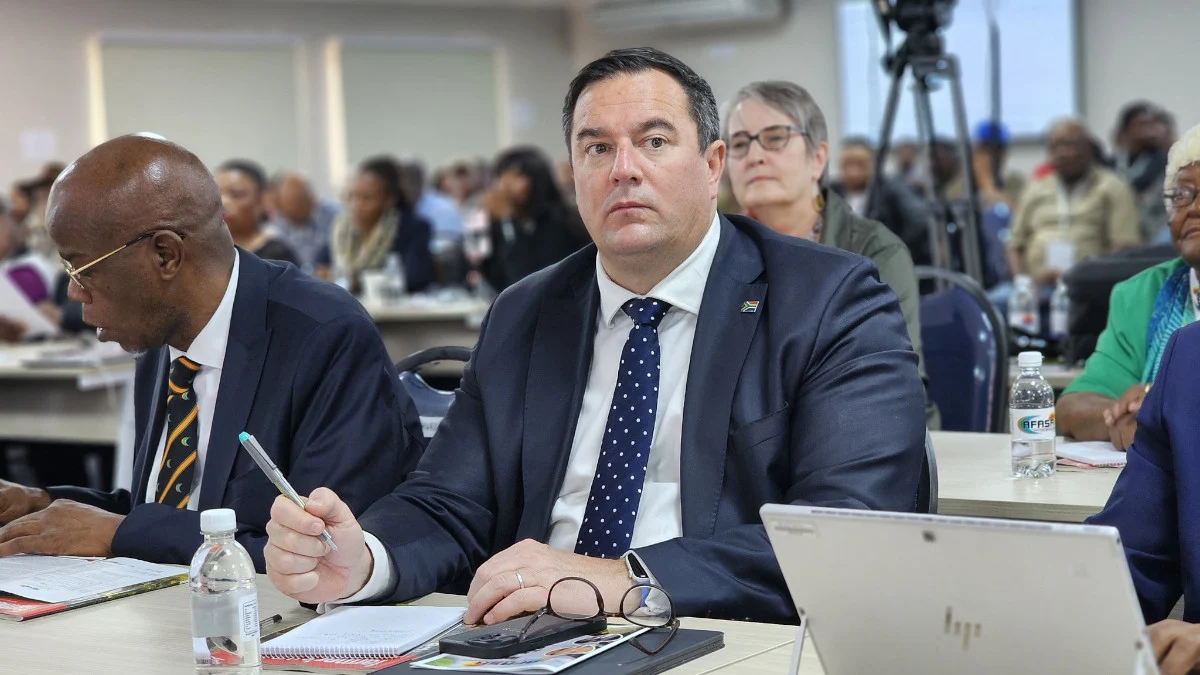
This week’s episode? The expected announcement that John Steenhuisen will not seek re-election as leader of the Democratic Alliance. For those unfamiliar with South African politics, this is not just another party reshuffle. This is the equivalent of removing one of the main characters from the only major political party in South Africa that is not spiritually, genealogically, or accidentally descended from the ANC.
Yes, ladies and gentlemen, the DA just pressed the big red “reboot character arc” button.
And from where I sit in Victoria Falls, juggling tourism marketing, basketball administration, and the occasional existential crisis about African politics, this moment is fascinating, complicated, hopeful, and deeply ironic.
First: Who Is John Steenhuisen and Why Should You Care?
John Steenhuisen has been leader of the DA since 2020. His tenure came after the departure of Musi Maimane, whose leadership era still sparks arguments strong enough to break WhatsApp family groups across Southern Africa.
Steenhuisen represented continuity. He was positioned as a steady, policy-focused administrator who would stabilise the party after internal fractures. Unfortunately, political leadership is not a Home Affairs queue. Stability alone does not excite voters.
However, Steenhuisen struggled with charisma. Politics, unfairly or not, is theatre. It is performance. It is emotional persuasion. It is the strange art of convincing millions of people that you understand their electricity bills and their grandmother’s medical aid simultaneously.
Steenhuisen’s tenure saw several controversies, including communication blunders, financial scrutiny, and public relations moments that landed with the grace of a giraffe attempting ballet.
But the bigger issue was electoral performance. The DA failed to significantly expand its voter base at a time when the ANC was historically weak. In politics, that is like missing an open goal with no goalkeeper present and then arguing about the quality of the grass.
The DA: South Africa’s Only Major “Non-ANC” Party
To understand why this matters, you have to understand the strange ecosystem of South African politics.
The ANC dominates South African political DNA. Even its rivals often originate from it. The EFF emerged from ANC Youth League rebels. The MK Party is literally led by a former ANC president. The ANC is basically the political equivalent of a family tree whose branches keep trying to pretend they are separate forests.
The DA stands alone as the primary party without ANC lineage. That makes it extremely important in South Africa’s democratic balance, particularly now under the Government of National Unity.
Which brings us to the GNU.
The GNU: South Africa’s Political Group Project That Nobody Fully Trusted But Everyone Had To Join
The Government of National Unity emerged after the ANC lost its outright majority in 2024. Think of it as the political version of students who hate each other being forced into a group assignment because nobody can pass alone.
The DA joining the GNU was historically significant. It placed them inside national governance structures, including ministerial portfolios. It also forced them into an awkward ideological marriage with the party they spent decades opposing.
Steenhuisen himself became Minister of Agriculture, which placed him directly inside policy execution rather than opposition rhetoric. That sounds impressive until you realise that governing means people blame you when cows get sick, vaccines are delayed, and farmers start writing angry open letters.
And that happened.
Enter Jordan Hill-Lewis: The DA’s New Golden Boy (Possibly)
If Steenhuisen exits, the expected successor is Jordan Hill-Lewis, the Mayor of Cape Town.
Hill-Lewis represents something South African voters are currently obsessed with. Competence at local government level.
Across South Africa, voters have developed a new political fetish. They want working traffic lights. They want water that arrives in pipes rather than philosophical speeches. They want mayors who fix potholes instead of tweeting quotes from Mandela without context.
Hill-Lewis has built a reputation as a technically competent mayor. Not universally loved, certainly criticised, but widely viewed as administratively effective. In modern South African politics, that is basically the equivalent of scoring a hat trick.
The DA believes he could transform local governance credibility into national electoral appeal.
Why This Matters Beyond South Africa (Yes, Even Here In Victoria Falls)
Zimbabwe watches South African politics the way younger siblings watch their older brother drive a car they occasionally crash but still somehow keep running.
South Africa’s political stability affects trade, tourism, migration, currency confidence, and regional policy leadership. When South Africa sneezes, Zimbabwe often develops a mild but financially inconvenient flu.
A stronger DA leadership could reshape opposition politics across Southern Africa. Many regional opposition movements study DA strategies, messaging, and governance models.
From Victoria Falls, this matters deeply. Tourism markets depend on regional stability. Economic confidence travels across borders. Even our conversations about governance and service delivery are influenced by what happens in Pretoria and Cape Town.
Now Let Me Address The Extremely Complicated Conversation About White Leadership In Africa
This is the part where nuance matters more than Twitter takes.
I believe white Africans are Africans. Full stop. History, belonging, and identity are not removable with airport departure stamps. White South Africans have built businesses, communities, and cultural identities rooted in the continent.
But we must also confront colonial legacy honestly.
Colonialism created structural inequality that still shapes land distribution, wealth patterns, and political mistrust across Africa. Ignoring that reality is intellectually dishonest and morally lazy.
African democracy requires reconciliation between inclusion and historical correction. That is an incredibly delicate balancing act.
The DA often struggles with this. The party’s support base and leadership demographics historically reflected South Africa’s minority communities, which made expansion into broader African voter bases politically complicated.
Steenhuisen’s leadership sometimes struggled to emotionally connect with voters who still see political representation through the lens of historical exclusion. Hill-Lewis may face the same challenge.
The DA’s future success depends on convincing South Africans that it understands inequality not just as policy statistics but as lived historical trauma.
The Real Political Stakes: 2026 And 2029
South Africa’s 2026 local government elections will set the tone for the 2029 national election. Every political strategist in Johannesburg is already sweating through their suits about this timeline.
The DA needs momentum. They need voter excitement. They need a leader who can expand their base into black urban voters, coloured communities drifting toward smaller parties, and young voters who currently trust no political institution at all.
Hill-Lewis represents a calculated gamble. Youthful. Administrative. Less politically controversial than party veterans.
But South African voters are complicated. They demand service delivery, emotional relatability, historical sensitivity, and policy credibility simultaneously. That is basically asking one politician to be Nelson Mandela, Elon Musk, and a local ward councillor at the same time.
Final Thoughts: South African Politics Remains The Most Entertaining Lecture You Never Signed Up For
Steenhuisen leaving may not change South Africa overnight. But it signals something deeper. The DA knows it must reinvent itself to remain relevant.
The GNU experiment continues. The ANC searches for future leadership. The opposition searches for national resonance. And Southern Africa continues watching like loyal viewers who complain about the plot but never miss an episode.
From Victoria Falls, I will keep watching too. Mostly because regional stability matters. Partly because African democracy deserves every chance to succeed. And slightly because South African politics is still the greatest reality show Africa has ever produced.
And unlike reality TV, this one determines whether the lights stay on.